May the ghost be with you!

Halloween aka Hallowe’en is celebrated each year on 31 October.  According to the ancient Celtic calendar, it was observed as the last day of each year, when all witches and warlocks were absent. After the introduction of Christianity, it was taken over as the eve (even or e’en) of All Hallows or All Saints. By the 20th Century it became what we know now as a great party occasion in our social calendar. 

Yesterday, I went for a walk around our neighborhood and saw a couple of houses adorned and ready for tonight’s’ Halloween Trick or Treat festivities. Mostly, there was an over-abundance of fake cobwebs, big plastic spiders and/or pumpkin faces, but I laughed out loud when I saw on the front lawn of one house two fake tombstones with R.I.P. inscribed and in front of them a pair of hands poking out through the grass lawn in front of each stone. (Took me back to my early days when my father took me to the movies to see those sensational B-Grade vampire movies, where we would laugh our way through until we had tears streaming down our faces).

It was also back in “the good old days” when we would hand-carve a pumpkin and put a candle in the middle to light-up to produce an eerie effect and/or perform massive acts of ‘misconduct’ and suffering mother’s ire by ‘mucking up’ or cutting up the white sheets to make peep-holes in our ghostly attire costumes for the night.

The graphics shown here are from “Graffik; a Canberra based street artist collective; who have provided original, large-scale murals and signs which have transformed commercial and residential walls into eye-catching features.  Every few months the walls around the  Canberra CBD are updated with different themes, which may vary from the Multicultural Festival, Winter in the City, Floriade and/or Christmas in the City to name but a few.

By the way, Halloween is often observed as a two-day event in some communities, as the following morning (November 1), acknowledges  “All Hallows Day”aka “All Saints’ Day”  which venerates all Christian saints. The derivation of its name ‘All Hallows’ originates from the Old English “halig” (meaning Holy).

Trick or treat? – Well  I prefer treat – LOL (Loving the Lollies) that is!

Website | About | Facebook | Twitter

“Is It Art?”
Posted in DarkArt, Horror & Fantasy Stories, SprayCanArt, Street Artists A-Z, StreetArt | Tagged , , , , , | Leave a comment

The Divine Sarah: The most famous actress the world has ever known

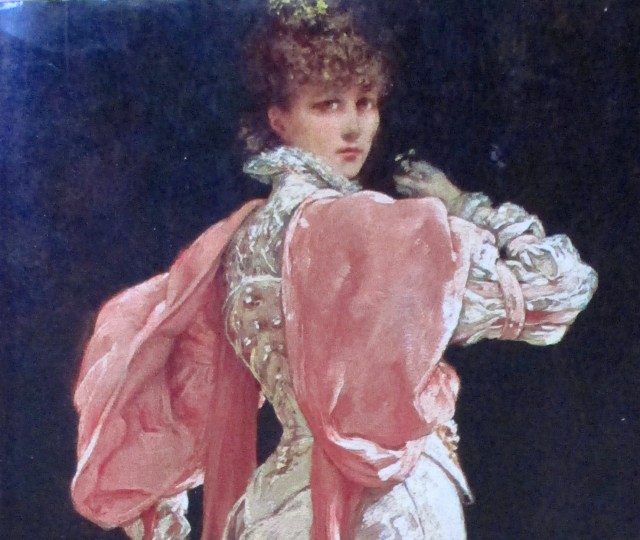
george clairin - sarah bernhardt Portrait of French stage and early film actress Sarah Bernhardt in her role as the Queen in Victor Hugo’s “Ruy Blas”  (1879), by artist  George Clairin (1843-1919).  Over her full and fascinating career, Sarah’s close friends included several artists, such as Clairin and Gustave Doré as well as the famous French author Victor Hugo. Other notable artists she sat for include Art Nouveau poster and postcard artist Alphonse Mucha. Adding to the Bernhardt fascination, was the suggested relationship with French female Impressionist artist Louise Abbéma, whom was often referred to as her lover despite being some nine years younger than Bernhardt.

Sarah was born in Paris as Rosine Bernardt, on 23 October, 1844. According to Wikipedia; she has often been described as “the most famous actress the world has ever known.” When Sarah was young her mother sent her to Grandchamp, to an Augustine convent school near Versailles. In 1860 she began attending the Conservatoire de Musique at Déclamation, Paris and became a student at the Comédie Française where she debuted in 1862 in Racine’s Iphigénie to lacklustre reviews. Around the same time, Bernhardt also began her working life as a courtesan in Paris. She became the mistress of Belgian nobleman, Charles-Joseph Eugène Henri Georges Lamoral de Ligne (1837–1914), the son of Eugène, 8th Prince of Ligne, with whom she had her only child, Maurice Bernhardt who was born in 1864. Because Maurice’s birth was out of wedlock, the Prince’s family refused any proposition of marriage and forced Bernhardt to end their relationship.

Despite her personal life experiences, Bernhardt developed a reputation as a serious dramatic actress earning the title “The Divine Sarah“; and was considered the most famous actress of the 19th Century. During this time she acquired her infamous coffin, in which she often slept in lieu of a bed – claiming that doing so helped her understand her many tragic roles portrayed in theatre.

  • She secured a contract at the Théâtre de L’Odéon where she began performing in 1866. Her most famous performance there was as the Florentine minstrel in François Coppé’s Le Passant (Jan. 1869).
  • One of her remarkable successes was in the title role of Voltaire’s Zaïre (1874).
  • She later married Greek-born actor Aristides Damala (known in France by his stage name – Jacques Damala) in London in 1882, but the marriage ended upon his death in 1889 at age 34, due to his dependence on morphine.
  • It was around this time that she was said to have been involved in an affair with the future King Edward VII while he was still the Prince of Wales.
  • She traveled to Cuba and performed in the Sauto Theater in Matanzas (1887).
  • In between tours Sarah took over the lease of the Théâtre de la Renaissance, which she ran as producer-director-star from 1893-1899.
  • In 1899 she took over the former Théâtre des Nations on the Place du Châtelet, renaming it the Théâtre Sarah-Bernhardt and opening on 21 January, 1900 in one of her most admired parts – the title role in Victorien Sardou’s La Tosca.

In 1910, Bernhardt was part of a scandalous production of “Judas” by John Wesley De Kay. It performed in New York’s Globe Theatre for only one night in December 1910 before it was banned. Its plot was considered extremely scandalous. It concerned Mary Magdalene, who was portrayed as a lover of Pontius Pilate; then later of Judas Iscariot; before becoming involved with Jesus. Its story suggested that Judas; after realizing that Mary Magdalene had given herself to Jesus; decided to betray his friend to the Romans. What shocked the audience the most, was the realization that the role of Judas was performed by Sarah Bernhardt. This production was also banned in Boston and Philadelphia.

  • Despite her continuing fame and notoriety, Bernhardt continued to direct the Théâtre Sarah-Bernhardt in Paris, until her death; when her son Maurice took over. After his death in 1928, the theatre retained the name until Occupation by the Germans in WW2 when the name changed to the Théâtre de la Cité  due to Bernhardt’s Jewish ancestry.
  • Despite living an exotic and controversial life, The Divine Sarah” – Sarah Bernhardt died on 26 March, 1923.

Website | About | Facebook | Twitter

“Is It Art?”

Posted in Artists A-Z, Gallery Art, Paintings, Performing Art | Tagged , , , , , , , | Leave a comment

Hunter: For the Record – We was Rob’d

rob hunterOctober 20, 2015 marks the fourth anniversary of the death of Rob Hunter from the legendary MC collective Syllabolix or SBX Crew. Known as Hunter or Huntz, he was an Australian MC rapper and hip hop artist known for writing raps about his home and life around Perth in Western Australia (W.A.).

Robert Alan Hunter  was born on October 1, 1975, in the Perth suburb of Yokine.

As part of the SBX Crew, Hunter released a total of four albums:

  • Done DL (2002), released in collaboration with Downsyde’s Dazastah on the Syllabolix label via Obese Records.
  • Going Back to Yokine (2006) nominated for the W.A. 2006 Music Industry Awards.
  • Monster House (2010) in collaboration with Sydney-based D.J. Vame.
  • Fear and Loathing (2011) with producer Mortar (Roy Mortimer). Together they explored the slow shift from carefree days of boozing and partying to the colder truths of ill health, relationship struggles and depression. Five years in the making, the album features SBX crew-mates Layla, Dazastah, Optamus and Graphic, and the Hilltop Hoods.

On hearing his diagnosis with terminal neuroendocrine cancer in November, 2009, Hunter wrote: “I was diagnosed with cancer. Neuroendocrine tumours on the pancreas with metastasis to liver… I was devo’d of course as this is pretty much a death sentence.

When members of the Australian hip hop community found out, they banded together to raise money for the MC and ultimately for his young son Marley and his partner, Laura. In November 2010, a charity eBay auction was organised by fellow MCs, Bias B and Len One called Heat 4 Huntz to raise money to help Hunter and his son. The one week eBay auction raised more than $11,000 through donation and sales of rare local releases, signed merchandise and records.

In August,2011, two months before his death, Hunter performed one of his last live shows  at the Railway Hotel, with Mortar, performing the entire Fear and Loathing album.

Hunter chose to collaborate with documentary film-makers Periscope Pictures who followed his journey throughout. Entitled Hunter: For the Record, it recorded the final years of his life.  The documentary’s premiere screening was at the Australian Centre for the Moving Image (ACMI) in Melbourne on October 27, 2012, with a second screening in Perth on November 1, 2012.

At the time of his death, Hunter was working on a charity album in support of youth cancer organisation, CanTeen. The album, Australian Hip Hop Supports CanTeen, was released on 2 December 2011, and completed with the help of fellow SBX crew member, Dazastah. It includes songs by Bias B, Drapht, Downsyde, Hermitude, the Hilltop Hoods, Hunter and Koolism,

Since his death of on 20 October,  2011 at the age of 36, Hunter was posthumously inducted into W.A. Music Industry Awards Hall of Fame; and has been commemorated by an “AUS All Star” gig and an inaugural Australian rules match, named the Robert Hunter Cup.

Website | About | Facebook | Twitter

“Is It Art?”

Posted in Angels, DarkArt, StreetArt | Tagged , , , , , , , , , , , , | Leave a comment

Cranach the Younger | There’s so much you have to know

Can you honestly believe that it was 500 years ago that the German Renaissance artist, Lucas Cranach (the Younger) was born? By looking at two examples of his most prestigious output, it would appear that his works look ‘as fresh as a daisy’; as if they were painted just yesterday.

Known for his woodcuts and paintings, on the left is: “Cupid Complaining to Venus.”  But what do we know about the artist Lucas Cranach the Younger?

He was born on 4th  October, 1515, the youngest son of Lucas Cranach the Elder and Barbara Brengebier. They lived in the city of Kronach, Franconia  (Germany).  Cranach the Younger began his career as an apprentice in his father’s workshop. He worked alongside his brother Hans and after his father’s death, he assumed control over the workshop (according to Wikipedia).

(On right) Apollo and Diana.  On 20th February, 1541, Cranach married Barbara Brück.  As a family, they had four children; three sons, and a daughter. Barbara died on the 10th February, 1550. 

On May 24, 1551, Cranach remarried – to Magdalena Schurff.  Together, they had three daughters and two sons, including Augustin Cranach (who is known for portraits and simple versions of allegorical and mythical scenes). In all, over his lifetime, Cranach became father to nine children before his death on 25th January, 1586.

Artistically, his painting style was similar to that of his father and because of this;  there have been challenges to differentiate between “father & son’s work”. 

This reminds me of an all-time favorite song by Cat Stevens called “Father & Son” which may have been apt for the father and son spiritual and artistic partnership of “Cranach and Son” ... (my interpretation), but  let’s all sing-along  now.

Just relax, take it easy
You’re still young, that’s your fault
There’s so much you have to know.”

Website | About | Facebook | Twitter

“Is It Art?”

Posted in Artists A-Z, OilPainting, Paintings | Tagged , , , , , , | Leave a comment

Stanton Deliver… Don’t Run Away, Don’t Run Away…

eric stanton

American bondage and fetish illustrator, cartoonist and comic-book artist; Eric Stanton (Ernest Stanzoni) was born on September 30, 1926 and raised in New York City. He attended the Cartoonists and Illustrators School and began specializing in erotic bondage comics such as Movie Star News. After this, Stanton embarked on a career as a self-publisher distributing his work to a quasi-underground network of subscribers and patrons featuring female dominance scenarios.

  • According to Wikipedia, during the 1950s-1960s, some of his most famous work centered around the super-heroine characters  including: Blunder Broad and the Amazonian Princkazons.  
  • In addition to books about his work, Stanton’s art was reprinted in the 1990s in a comic book from Fantagraphics Books’ imprint Eros Comix, Tops and Bottoms.
  • Also, his “Stantoons comic-book series continued until his death on March 17, 1999.

Whatever you think of this form or artwork, do not ask me for my opinion, for I do not “Stanton any particular scruples!”

Website | About | Facebook | Twitter

“Is It Art?”

Posted in Artists A-Z, Erotic Art, Illustrations | Tagged , , , , , , , | Leave a comment

Don’t be a bunny… this might be the one-y!

Featured above is “The Sunbath,” (1913) oil on canvas by Australian artist Rupert Charles Wulsten Bunny; who was born on the 29th September 1864.

Rupert Bunny achieved success and critical acclaim as an expatriate in fin-de-siècle in Paris and received an honorable mention at the Paris Salon in 1890 with his painting Tritons. Around 1895, Bunny met his wife Jeanne Heloise Morel who became his principal model, but they did not marry until 1902. Bunny continued to live in France and Australia, travelling between the two countries frequently until 1933 when Jeanne died. It was then that he decided to return permanently to Australia, where he settled in the Melbournian suburb of  South Yarra, not far from the bayside suburb of St. Kilda, where he was born; and remained in South Yarra for the next 14 years until his death on 25th May, 1947.

Image on the right is: Endormies (ca.1904) Oil on canvas (130.6 x 200.5cm). Many of his works from this era include a red rose; an ancient symbol of love, beauty and sensuous power; which is also considered to be the symbol of the recurring motif of Belle Epoque culture. Bunny was a bronze medal recipient at the Paris Exposition Universelle, (1900) for his Burial of St. Catherine of Alexandria.  Over the years, France acquired 13 of his works for the Musée du Luxembourg and other regional collections.

I adore his work, and if I had the opportunity – I would put my money on the Bunny!

Website | About | Facebook | Twitter

“Is It Art?”

Posted in Artists A-Z, Erotic Art, OilPainting, StreetArt | Tagged , , , , , | Leave a comment

The Grand Lord of Gothic Lushness – Cave or Arkley?

howard arkley - nick cave (2)Portrait of Nick Cave (1999) by Howard Arkley (1951-1999). Synthetic polymer on canvas, commissioned with funds provided by L. Gordon Darling AC CMG, 1999. Arkley’s portrait of Nick Cave was the first work commissioned by the National Portrait Gallery and one of the last works he completed.

Nick Cave (or Nicholas Edward Cave) was born on 22nd September, in 1957 at Warracknabeal, Victoria, Australia. Cave is an Australian musician, songwriter, author, screenwriter, composer and occasional film actor. He is best known for his musical work with his band Nick Cave and the Bad Seeds whose lyrical motifs revolve around the themes of religion, death, love and violence.

  • In fact, in the early 2010s, Cave was dubbed by the New Musical Express (NME) magazine as “The grand lord of Gothic lushness“.

Earlier incarnations of his musical career included his time as front-man for The Boys Next Door and later for the post-punk band The Birthday Party in the early 1980s.  Around this time, Cave began to use the Old Testament imagery within his lyrics about sin, curses and damnation.

Their single “Release the Bats” (1981), became highly influential in the Gothic genre. At that time, Cave also became a regular member of a Gothic club in London called The Batcave. A few fast facts on his early life:

  • Cave’s father taught English and maths at the local school; and his mother was the librarian.
  • In 1966, Cave joined the Cathedral choir of Wangaratta’s Holy Trinity Cathedral at the age of nine.
  • In 1970 at the age of 13 he was expelled from Wangaratta High School and became a boarder and later a day student at Caulfield Grammar School in Melbourne.
  • After his secondary schooling, Cave studied painting (Fine Art) at the Caulfield Institute of Technology (now Monash University), in 1976, but dropped out in 1977 to pursue music and began experimenting and using heroin around the time that he left art school.
  • It was around this time that Cave’s father was killed in a car accident; and at the moment he was informed of this, his mother was bailing him out of a St. Kilda police station for a charge of burglary.
  • Recently his song Red Right Hand was used on a successful TV advertisement to Visit South Australia using imagery to accompany his lyrics

Take a little walk to the edge of town and go across the tracks
Where the viaduct looms,
like a bird of doom As it shifts and cracks
Where secrets lie in the border fires,
in the humming wires
Hey man, you know you’re never coming back
Past the square, past the bridge, past the mills, past the stacks
On a gathering storm comes a tall handsome man
in a dusty black coat with a red right hand

… and as much as I love that song, maybe you might prefer me to be your Wild Rose… “If I show you the roses will you follow?“(from “Where the Wild Roses Grow”)

Website | About | Facebook | Twitter

“Is It Art?”

Posted in Artists A-Z, Gallery Art, OilPainting, Rogue's gallery | Tagged , , , , , , , | Leave a comment

Hush my darling, don’t fear my darling, the lion sleeps tonight

paul meyerheim - jealous lioness 1885-90When I get together with ‘the girls’, we spend a day at the art gallery and inevitably lunch, brunch and/or coffee break together as part of our wonderful cultural day out experience. We have a rule which stipulates that the post-gallery gathering is a time where we each declare and describe the “one and only” item we would like to keep or own, from that exhibition.  After one such occasion, the majority agreed on this particular painting for either its vivaciousness, liveliness, or its lionness qualities. However, you could have heard a pin drop when I said, it was because I liked the green parrots sitting on the female lion-tamers shoulder. This was shortly followed by a chorus of “what parrot…where?

The work in question is Paul Meyerheim’s “Jealous Lioness,” oil on canvas (c.885-1890) from the collection of the Städelsches Kunstinstitut und Städtische Galerie, Frankfurt am Main, Germany, acquired in 1903.

Berlin artist and graphic artist Paul Friedrich Meyerheim (13 July 1842 – 14 September 1915) is best known for his paintings of animals. As a young child he was fascinated with the Berlin Zoological Gardens and frequented it so often that he was  befriended by its founder, Martin Lichtenstein. Because of this friendship, Lichenstein allowed the young Meyerheim into areas of the zoo that were normally closed to the public. It was through this experience, combined with  his father’s art tuition which led Meyerheim to specialize in animal painting.

  • For three years, (1857-1860) he attended the Prussian Academy of Arts.
  • Later, he made several study trips to Switzerland, Belgium and The Netherlands and spent a year in Paris, France.
  • In 1883 he established an animal painting class at the Academy and in 1887 he was appointed an Academy Professor and became a member of the Academic Senate.

Meyerheim was a friend of the Borsig family and produced many illustrations and designs for the Borsig-Werke, which manufactured railroad locomotives. A major attraction at the Great Berlin Art Exhibition in 1912 was a series of seven huge images, painted on copper, that Meyerheim  created during 1873-1876.

These were called “Lebensgeschichte einer Lokomotive” (Life History of a Locomotive) and were originally intended for the garden loggia at the Borsig home in Alt-Moabit.

  • Some of these panels are now in the possession of the Märkisches Museum in Berlin-Mitte and the Deutschen Technikmuseum.

Awimbawe!

Website | About | Facebook | Twitter

“Is It Art?”

Posted in Artists A-Z, Gallery Art, OilPainting, Paintings | Tagged , , , , | Leave a comment

De Profundis to Larry Sitsky and Mary Brady

mary brady - larry sitsky137 year-old composer Larry Sitsky is depicted in this 1971 Portia Geach Prize winning portrait by self-taught artist, Sister Mary Brady.  He is a pianist, scholar and a founding member of the Canberra School of Music at the Australian National University.  As a major composer, his compositions cover a wide genre from: opera, theatre and orchestral scores; as well as chamber, solo and vocal music compositions.

Larry (aka) Lazar Sitsky was born to Russian-Jewish émigré parents, on 10 September, 1934, in Tianjin, China. He studied piano from an early age and gave his first public concert at the age of nine.  Along with his family; he emigrated to Sydney in 1951.  Some of his work includes:

  • Operas – The Fall of the House of Usher (1965), Lenz, (1970),  and Fiery Tales, (1975) after Chaucer and Boccaccio, Voices in Limbo, (1977), The Golem, (1980), De Profundis (1982) and Three scenes from Aboriginal life
  • Ballet – Sinfonia for Ten Players (“The Dark Refuge”) (1964)
  • Solo InstrumentImprovisation and Cadenza for solo viola (1964)
  • Orchestral – Symphony in Four Movements (premiered by the Canberra Symphony Orchestra under Robert Bailey, 23 May 2001)
  • Vocal – Incidental music to Faust  for solo piano and three sopranos (1996), Seven Zen Songs for voice and viola (2005), De Profundis (1982)

The Artist – MARY BRADY (1922-2014)
Champion golfer and Dominican sister, Mary Brady was born in Tamworth on December 17, 1922. From an early age she was always fascinated by art and although she never belonged to an art school she learned her art by reading every “how to” art book she could acquire from the travelling library that came up to Tamworth on the train from the Public Library of New South Wales.  Later on, through her golf friends, she met Mother Margaret Mary Lyons from the Dominican Convent, in Tamworth, who was a painter, art teacher and eventually became Brady’s art mentor.

In 1967, Brady became a Dominican Sister and and found that she could still pursue her love of painting; although her golfing opportunities had ended. Sadly, Mary Brady died in 2014.

  • Mary Brady the artist became a three-time winner of the Portia Geach Memorial Award for Portraiture; finalist in the Archibald Prize;  a regular finalist in the Sulman and Wynne Prize lists; as well as being the recipient of many regional art prizes.

This portrait is part of the collection of the National Portrait Gallery Canberra; provided courtesy by gift from Larry and his wife, Magda Sitsky, in 2010. (Oil on composition board – 120 x 90 cm)

Website | About | Facebook | Twitter

“Is It Art?”

Posted in Artists A-Z, OilPainting, Paintings | Tagged , , , , , | Leave a comment

“I had such extreme feelings…I wanted to convey this.”

Ben Quilty is an Australian artist born in Sydney in 1973 where he spent his formative years growing up in Sydney’s north-west suburb of Kenthurst. He graduated from Oakhill College and then continued his studies at the Sydney College of the Arts at the University of Sydney. He followed this with further study, graduating from the University of Western Sydney with a Bachelor of Visual Communication.

Quilty acted as an Australian Official War Artist in Afghanistan from 11 October-3 November, 2011, when he was attached to the Australian Defence Force (ADF) observing their activities to record and interpret the experiences of Australian service personnel who were deployed as part of Operation Slipper, in Kabul, Kandahar and Tarin Kowt.  (On left is “Trooper Luke Norman After Afghanistan” (On loan from the artist,  Australian War Memorial, Canberra, ACT).

After his return, Quilty spent 6 months producing artworks for the Australian War Memorial’s National Collection.  His experiences and artwork as a War Artist was shown on the Australian Broadcasting Corporation (ABC)  Program “War Paint” (one of the series of the Australian Story) screened on TV on 3 September, 2012.

On the right is “Captain S. After Afghanistan” painted in Robertson, NSW, 2011. Oil on linen (On loan from the artist,  Australian War Memorial, Canberra, ACT). Quilty asked the soldiers to sit for their portraits naked. He needed to see the body after its protective layers of uniform and body armour had been stripped away. For him, their nakedness expressed both the strength and the frailty of the human condition in time of war. The pose for this painting was chosen by Captain S and reflects an experience he had whilst serving in Helmand Province, Afghanistan. Taking cover behind a low mud-brick wall, he spent 18 hours under constant fire from insurgents. A Fellow soldier had been hit in the upper leg and Captain S. called in support from an Apache gunship to allow the medivac helicopter to evacuate the wounded soldier.

These days, Quilty lives and works in Robertson, New South Wales. A talented artist, he has so far won the following prizes:

  • Brett Whiteley Travelling Art Scholarship (2002).
  • His painting Dead (Over the Hills and Far Away) won the National Artists Self Portrait Prize  (2007);
  • Doug Moran National Portrait Prize, Australia’s most lucrative portrait prize, for a painting of Australian musician Jimmy Barnes 2009;
  • Archibald Prize, for his portrait of Australian artist Margaret Olley. (2011 on his 7th entry to the prize); and the
  • Prudential Eye Award (2014).

Of his deployment, Quilty has commented: “I had such extreme feelings about the smell, sound, emotions of being in Afghanistan … I wanted to convey this.”

Website | About | Facebook | Twitter

“Is It Art?”

Posted in Artists A-Z, Gallery Art, OilPainting, Paintings | Tagged , , , , | Leave a comment

Flipover Lamb at dinner is no recipe for disaster

Please be seated for your dinner service on board the Orient Line’s S.S. Orcades  menú for Thursday 19th September, 1957. On this night the table menú looks a little topsy-turvy or perhaps considered a flipover menú for those seated at the table, wishing to play with their menus.

Lamb’s menú displays the upside down-ness also known as “inversion illusions” where the invertive derivative comes from the Latin verb ‘invertere’, which means ’to reverse’ or ‘to flip over’. Despite its entertaining and interactive menú, foodies may be interested in the menú suggestions recommended by the liner’s chef for this particular night’s repast, which includes:

Soup de jour: Creme Montespan
Entree: Braised lamb’s sweetbreads Bonne-Maman
Main: Grilled fillet of Dover sole with parsley butter or,
Roast dairy-fed pork served with sage and onion with apple sauce
Dessert: Chocolate nut sundae.

Wine by the glass includes:
Burgundy Les Abbesses, Cote de Beane Villages (Buchard Aines,) 1953

Born on 15 April, 1907, the menú designer was Lynton Lamb who was an English artist, designer, author, lithographer and illustrator who was notable for his  architectural decorations and postage stamp designs.

The son of the Reverend Frederick Lamb in Nizambabad, India, Lynton grew up in London and was educated at Kingswood School, Bath, Somerset. He then worked in an Estate Agents office and attended night school at Camberwell School of Art before studying art full time at the Central School of Arts and Crafts. From 1930 he was employed at the Oxford University Press designing book jackets.

  • He exhibited works at the Festival of Britain in 1951 and designed the binding of the Bible used at the Coronation of Queen Elizabeth II.
  • In 1953/54 he designed the Queen Elizabeth II Castle series high-value definitive postage stamp issue which featured views of four castles in England, Scotland, Wales and Northern Ireland framed by an old stone wall later nicknamed the ‘broken grotto.’  This series received the International Philatelic Art Society Award for their design in 1960.
  • Lamb was head of lithography at the Royal College of Art and Slade School of Fine Art and was named ‘Royal Designer to Industry‘ in 1974.
  • He lived in retirement in Sandon, Essex where he died aged 70, on the 4th September, 1977.

Lamb’s menú was produced for the evening meal on board the S.S. Orcades, to help celebrate the cruise ship’s crossing of the Equator and as we all know, what is observed on one side of the equator is reversed on the other – thus one needs to invert or flip-over the menú during this transition to fully appreciate this great equatorial experience.

Bon voyage et bon appetit!

Website | About | Facebook | Twitter

“Is It Art?”

Posted in Artists A-Z, Illustrations | Tagged , , , , , | Leave a comment

Henry’s statues are so Moorish

henry-moore1Two Piece Reclining Figure #9″ (1968) bronze situated outside the  National Library of Australia, Canberra.

English sculptor and artist Henry Spencer Moore was born in Castleford, West Yorkshire on 30th July 1898. He is best known for his reclining human-figure semi-abstract monumental bronze sculptures.

In his informative years Henry experimented with modelling in clay as well as carving in wood.  At the age of 11 he wanted to become a sculptor which was encouraged by his art teacher and against his parents will. Despite this, he continued his art studies but they were briefly interrupted at the age of 18, when Moore volunteered for army service where he became the youngest local intake into the Prince of Wales’s Own Civil Service Rifles regiment.

After his WW1 service, Moore received an ex-serviceman’s grant to continue his education; and in 1919 he became a student at the Leeds School of Art, which set up a sculpture studio especially for him. It was here that he met Barbara Hepworth, a fellow student who would also become a well-known British sculptor.  In 1921, Moore, Hepworth and other Yorkshire contemporaries won a scholarship to study at the Royal College of Art in London.

In 1924, Moore won a six-month travelling scholarship where he visited Paris and took advantage of the timed-sketching classes at the Académie Colarossi.  On returning to London, he undertook a seven-year teaching post at the Royal College of Art; and in July 1929, he married Irina Radetsky, a painting student at the Royal College. Irina and Henry moved to a studio in Hampstead, London, joining a small colony of avant-garde artists including Barbara Hepworth and her second husband Ben Nicholson, who moved into a studio around the corner from them.

After their Hampstead home was hit by bomb shrapnel in September 1940, during WW2, Moore and Irina moved out of London to live in a farmhouse called Hoglands in the hamlet of Perry Green near Much Hadham in Hertfordshire, which would become Moore’s home and workshop for the rest of his life until his death on 31st  August, 1986, at the age of 88. His body is interred in the local  Perry Green churchyard.

Strangely, Moore’s work has frequently been subject to vandalism, especially in Europe and America. Some of these incidences include:

  • King and Queen (1952–1953) sculptures were decapitated in Dumfries (1995) and daubed with blue paint in Leeds.
  • Recumbent Figure also decapitated during a wartime loan to the Museum of Modern Art, New York
  • Spindle Piece (1968–69) was vandalised with metal chains in Houston.
  • Draped Seated Woman (1957–58) was tarred and feathered at Von der Heydt Museum in the Ruhr.
  • Reclining Figure (1969–70)  a 2 ton sculpture was lifted by crane from the grounds of the Henry Moore Foundation onto a lorry  in December 2005 and has not been recovered. Insurance stands at £3 million.
  • Sundial (1965) and the bronze plinth of another work were stolen from the Foundation’s estate and the two male perpetrators of the crime were caught and jailed for a year in 2012 for stealing them.
  • Standing Figure (1950), one of four Moore pieces in the Glenkiln Sculpture Park, estimated to be worth £3 million, was stolen in October 2013.

So, if you know of any sculptural body parts that are looking for a bodily home which may fit the scenarios described above, you might need to draw Moore attention to this!

Website | About | Facebook | Twitter

“Is It Art?”

Posted in Sculpture | Tagged , , , , | Leave a comment

The everlasting truth and loyal love of the gift of Fantin-Latour

French painter and lithographer Ignace Henri Jean Théodore Fantin-Latour was born on 14th January, 1836 in Grenoble, Isère, France.  The son of an artist, young Henri took drawing lessons from his father before entering the Ecole de Dessin, in 1850 at the age of 14, where he studied with Lecoq de Boisbaudran.

Four years later he went on to study at the École des Beaux-Arts in Paris and upon graduation, began working for the Musée du Louvre, copying old masters.

Henri was best known for his flower paintings and group portraits of Parisian artists and writers. In addition to his realistic paintings, he created imaginative lithographs inspired by the music of some of the great classical composers of the time.

Although he became associated with Impressionist art and its artists such as Whistler and Manet, Henri’s work remained conservative in style. He made considerable success in England with his still-life work, although these works remained relatively unknown in his native France.

In 1875 he married Victoria Dubourg, a fellow painter. From hereon in, the two spent  their summers on Victoria’s family estate at Buré, Orne in Lower Normandy. It was here that Henri died of Lyme disease on 25th August, 1904.  He was later interred in the Cimetière du Montparnasse, in Paris.

  • One of his paintings, “A basket of roses” was used for the cover of New Order’s album “Power, Corruption & Lies” in 1983.
  • Above image consists of a vase of white chrysanthemums and by definition, these white flowers symbolize truth and loyal love.

Website | About | Facebook | Twitter

“Is It Art?”

Posted in Artists A-Z, Gallery Art, OilPainting, Paintings, StillLife | Tagged , , , , , , | Leave a comment

How Norimontir Became Aby Altson’s Paradise of The Golden Age

 Aby ‘Farmer ‘Altson was born on 21 August 1866 at Middlesbrough-on-Tees, Yorkshire, England.  Altson migrated to Australia from England to join his brother Barnett in 1883 and worked in his uncle’s leather and saddlery business. He began art classes at the Gallery School of Design in 1886 and spent his leisure with members of the ‘Heidelberg‘ painting school where he painted a number of small oil panels on cigar-lids from his brother’s tobacconist shop.

In 1890, he won a travelling scholarship to study with Gustave Courtois and Pascal-Adolphe-Jean-Dagnan-Bouveret at the Academie Julian in Paris. He won a salon Gold Medal for his painting Echoin 1892 and from 1894-1898 worked in London as an illustrator for The Westminster Magazine.

Between 1895 and 1936 Altson travelled frequently to India, and became the official portrait painter for several Indian maharajahs. When he migrated to the USA in 1937, he became a much sort-after women’s portrait painter. Among his best portraits is his prize winning 1889 portrait of his sister-in-law, which is in the National Gallery of Victoria. His Flood Suffering in 1890 was acclaimed by critics as “the best painting” of that year.

Altson died on 7th November 1948, at Elmhurst, New York.

  • For the composition “The Golden Age,” Altson had some degree of difficulty trying to obtain permission from land proprietors in France, in order to paint nudes in the open.  Eventually he succeeded and took his models to a remote and rarely visited area on the island of Norimontir, off the south-west coast of France.

Website | About | Facebook | Twitter

“Is It Art?”

Posted in Artists A-Z, Erotic Art, OilPainting, Paintings | Tagged , , , , , | Leave a comment

How Rachel’s Goodsir became My Fair Lady

agnes goodsirIn only 90 years, we have come full circle where we can once again be shocked by seeing a “Girl With Cigarette”.  Captured as a nouvelle societal attitude receptor of its day, Australian born artist Agnes Goodsir (ca. 1925) painted “Girl With Cigarette”, oil on canvas. It is part of the Bendigo Art Gallery permanent collection (Bequest of Amy E Bayne, 1945).

Agnes Noyes Goodsir was born on 18 June, 1864 in Portland, Victoria, one of eleven children of David James Cook Goodsir, Commissioner of Customs at Melbourne and Elizabeth Archer (née Tomlins). Her early art training began with Arthur T. Woodward at the Bendigo School of Mines and Industries (1898-1899) and in 1899 some of her work was raffled in Bendigo to partly finance her study in Paris.

Goodsir’s work showed strong composition and technique, favouring oils over watercolours. From ca. 1912 Goodsir shuttled between London and Paris, where she attended the Académie Delécluse; Académie Julian; and the Académie Colarossi. Her work was acclaimed and exhibited at the New Salon, the Salon des Indépendants and the Société Nationale des Beaux-Arts in Paris as well as at the Royal Academy and the Royal Institute in London.

Despite turning out a large number of still life and interiors, Goodsir’s forté was portraiture, including those of: Katharine Goodson, Leo Tolstoy, Ellen Terry, Banjo Paterson, Bertrand Russell, Dame Edith Walker, Countess Pinci and Benito Mussolini.

Finally settling at 18 rue de l’Odéon in Paris in 1921, Goodsir lived with her beloved companion Rachel Dunn, who was depicted in several of Goodsir’s paintings, including  The Chinese Skirt (1923),  The Letter (1926) and Morning Tea (1925) and Girl with Cigarette (1925) – featured above.

Goodsir died in Paris, France on 18th August, 1939.

  • Her paintings were left to her companion Rachel, who sent some 40 to Agnes’s family in Australia and others to Australian galleries.
  • The Goodsir Scholarship of the Bendigo Art Gallery is named in memory of her.

Website | About | Facebook | Twitter

“Is It Art?”

Posted in Artists A-Z, Gallery Art, OilPainting, Paintings | Tagged , , , , , | Leave a comment