Aboriginal art – Jowayili

moko's jowayiliDonald Moko is a senior lawman (and trained as a traditional maparn =medicine man), from the Mindi Mindi clan of the Yulparija. He was born at Kalajadu near Wangkatjungka, west of Well 33 on the Canning Stock Route in the Great Sandy Desert, Western Australia and grew up travelling with his parents around his traditional country.

He came to Bidyadanga in the late 1960s with his wife Mary Meribida and their children. In mid 2003, Moko and other senior people at Bidyadanga met with Emily Rohr, Director of Short Street Gallery, Broome, and a regular visitor to the community, requesting art materials so that they could start painting. Moko was one of the first to experiment with acrylic on canvas. His work was exhibited in the first Bidyadanga Artists group show Manjiliyajarra: An Exhibition by the Yulparija and Mangala Artists, at the Short Street Gallery, Broome in 2003.

This is a representation of his 2004 work “Jowayili“, acrylic on canvas (167x101cm). He also participated in the major contemporary exhibition 2004: Australian Visual Culture Now, at the Ian Potter Centre: NGV Australia in 2004. For more information click here.

Website | About | Facebook | Twitter

“Is It Art?”

Posted in OilPainting, Paintings | Tagged , , , | 2 Comments

There’s Something About Mary…

tim mcgonagleThat’s the Style, Mary” (2011), is the name of this large wall painting by Tim McMonagle. I was temporarily dumb-struck when I saw this some month’s back within the Holmesglen Contemporary  Australian Art Exhibition. This piece was away from the main gallery exhibition items but nonetheless on entrance, it can stop you in mid-tracks. In order to understand Tim’s piece, you need to understand the ‘tunnel vision’ he has used to depict a worker within a pre-21st Century, mining tunnel; which he has used as a metaphor for ‘contemporary man’s relentless pursuit of material gain‘.

These mining fore-bearers were often trapped in cavernous tunnels, furiously chipping away at fragments of elusive treasure for us to appreciate today. In this modern canvas, we get the opportunity to peer down into one of these cavernous craters, and in this case, to see a female miner.

I like Tim McMonagle’s approach and style to his art.

      • He paints directly onto linen.
      • He does not use any preparatory sketches or detail mapping before he applies the first daub or streak of paint.
      • He uses a square format for his works, therefore ensuring that each composition is resolute.

That’s why I say – “That’s the style Tim!”

Website | About | Facebook | Twitter

“Is It Art?”

Posted in StreetArt | Tagged , , , | Leave a comment

Clarice’s Table

clarices table megan abrechtClarice’s Table (gouache and acrylic) is a vibrant splash reminiscent of a Van Gogh floral still life. I saw this on exhibit many months ago at a winery which was show-casing local artist “Meg” aka Megan Hayley Abrecht.

Meg is a Gippsland artist and decorative painter living in Warragul. She loves exploring colour portrayed through intricate intense settings with feathers, art deco china, repetitive patterns in fabrics and flowers. Her style and inspiration include both Mediterranean and Parisian influences.  She quotes Van Gogh and Matisse as influential colour masters. She has moved from pastels, oils and now to gouache, finding it a quick drying medium with its vibrant colours which suits her work and gives her great pleasure. For more information on Megan Hayley Abrecht, click on her site.

For further artworks – see my A-Z Artists page.

Website | About | Facebook | Twitter

“Is It Art?”

Posted in OilPainting, Paintings | Tagged , , , | Leave a comment

Kombi-nation of VW manufacturing & art

combi cushionThis header and entry marks a new page category under “Is It Art?” – VW Art.  I base this on my love of the Kombi/Combi VW van.  In fact we are a family of devotees of this van and friends and family alike find Kombi paraphernalia for us. So, when I look at the collection, I realise that artists are at work creating Kombi items. Here’s one example.

Some years ago, a friend sent us this Martin Wiscombe designed postcard for our enjoyment. Martin, born and raised in Lyme Regis , Dorset, has studied illustration and design in the West Country prior to his transition to London.  After a successful career in advertising, Martin embarked on a new life painting and illustrating in Wiltshire. He took inspiration from the farmland around him and specialised in paintings and carvings of farm animals, and published a book about the old English rare pig breeds,  “The Old Pig” (2000).  He now lives and works in rural France with his wife, dogs and horses. Obviously he also likes Kombi vans. (Well, my story and I’m sticking to it).

Also, couldn’t resist it, so I thought I would also include a picture of one of a pair of cushions in similar motif. This is my VW Art page.

Website | About | Facebook | Twitter

“Is It Art?”

Posted in Cards, Illustrations, Postcards, StreetArt | Tagged , , | Leave a comment

Lost yours?…Found mine!

marblepotMarbles that is. Haven’t come across them for a long time, but there they were, preserved in a bowl!  I’ve got to admit, I didn’t really know how to truly follow this game. I think as a group of  local kids, we made up our own rules on how to play the game. But to be quite honest, I used to spend more time marveling at the color and intricacy of each marble and wondered how the colors got inside. So of course, now that I have been re-acquainted with my marbles (as if I would have ever lost them), I checked out Wikipedia and discovered when it comes to the design of a marble, there’s more to it than meets the eye. For example some of the different varieties are called:

  • Toothpaste – Also known as Plainsies in Canada. These have wavy streaks usually with red, blue, black, white, or  orange.
  • Ade – has strands of opaque white and color, making lemon-ade, lime-ade, orange-ade, etc.
  • Onionskin – marbles are antique, handmade German with a swirl, with many closely packed surface streaks.
  • Cat’s Eye looks exactly like that, with one central eye-shaped colored insert or core (injected inside the marble).

So how are marbles actually made? Well, they can be fashioned through glass rods stacked together to form a particular pattern; cutting the rod into marble-sized pieces using special scissors, and rounding the glass into the desired shape. Color is added to the main batch glass and/or to additional glass streams that are combined with the main stream in a variety of ways. For example, in the “cat’s-eye” style, colored glass veins are injected into a transparent main stream. Applying more expensive colored glass to the surface of cheaper transparent or white glass is also a common technique. For more information check out Wikipedia for Marbles. It’s marble-ous!

For further examples of glass, see my Decorative Arts – Glass category.

Website | About | Facebook | Twitter

“Is It Art?”

Posted in Glass, Marbles | Leave a comment

Titian by name & Titian by colour

There’s a certain reddish hair-color known as Titian and when I look at this painting and the color of the sitter’s hair, it dawned on me, is the name of the hair color named after the artist Titian? This portrait’s sitter is said to be Lavinia, the artist Titian’s daughter. Lavinia was born in 1530 after a difficult birth which  caused the death of Cecilia, Titian’s wife and mother of their two sons Pomponio and Orazio.  Strangely, Lavinia, who married Cornelio Sarcinelli of Serravalle in 1554, also died in childbirth in 1560.

But what of Titian, the Venetian himself? It seems that he died 437 years ago on 27 August, 1576 as a result of a plague which raged through Venice that year killing both he and his son Orazio. Titian, aka Tiziano Vecelli,  Tiziano Vecellio and da Cadore, (after his birthplace of Pieve di Cadore, in the Republic of Venice) was born ca 1490. After his death, he was interred in the “Frari” – the Basilica di Santa Maria Gloriosa dei Frari.

A prolific and admired artist, his many works are shared amongst many of the greatest galleries and collections around the world. This portrait is part of the Musee Gallerie Nazionale de Capodimante collection in Naples, Italy.

Website | About | Facebook | Twitter

“Is It Art?”

Posted in OilPainting, Paintings | Tagged , , , | 1 Comment

“I think he’s having a laugh”

franz halsThe Laughing Cavalier, previously known as The Cavalier, is a famous painting at The Wallace Collection in London. It was painted by Dutch “Golden Age Painter” Frans Hals back in 1624 (a mere 388 years ago). In fact, Hals, died on August 26, 1666 (356 years ago!). He was born ca. 1582 in Antwerp and spent most of his life in Haarlem and is buried there at St. Bavo’s Church.

Provenance for this portrait can only be traced back to 1770. It changed hands a couple of times, until it was purchased by the 4th Marquess of Hertford in 1865, who outbid Baron James de Rothschild for it. No doubt he was “laughing all the way to the bank“.

It was exhibited in 1888, at the Royal Academy, for the first time  as “The Laughing Cavalier“.  Marquess of Hertford’s  son, Sir Richard Wallace, inherited this and all of his father’s collection and following his death, his widow donated it as well as the London house to the nation as the Wallace Collection. If you have not seen this, you simply have to. Another famous painting and one of my all time favourite’s from the Wallace Collection is The Swing by Fragonard (mentioned in an earlier post).

Many claim that the Cavalier’s eyes follow you around the room, and many films, TV shows, comedy and horror productions often send this up, especially when they show versions of the painting with cut-out eyes and “real” eyeballs watching all those in the room therein.

So, who’s laughing now? Well, you know the old saying: “He who laughs last, didn’t get the joke.

Website | About | Facebook | Twitter

“Is It Art?”

Posted in OilPainting, Paintings | Tagged , , , , | Leave a comment

“…And Dream of Sheep”

As a child I remember times when I could not get off to sleep and my parents would say that all you needed to do was count sheep. With that, they would get up, turn my bedside lamp off for me and walk through the darkened bedroom, gently closing my bedroom door behind them. Then I would lay, with my eyes tightly shut and count one…two…three…four… and so on. Sometimes I would get to an almighty-high number and give up and think of something else.

The late and great Jake Thackray also knew a lot about ‘counting sheep’ and describes in one of his songs, a quirky, local, Swaledale (Yorkshire) method of counting sheep in his song  Old Molly Metcalf, (courtesy of YouTube upload) the counting method is thus:

“Yan, Chan, Tether, Mether, Pip, Azar, Sazar, Akka, Cotta, Dik, Yanadik, Channadik, Thetheradik, Metheradik, Bumfit, Yanabum, Chanabum, Thetherabum, Metherabum, Jiggit”. It’s weird and wonderful and I have never met anyone yet who has not laughed wholeheartedly.

counting sheepNow I know that “Counting Sheep” really does help you get to sleep and may help your unrelenting insomnia. I found this new product which just might do the trick. It’s not available from your local chemist or pharmacist, but if you hunt it down, you might be able to find it at your local off-license, pub, or drive-through bottle shop.  It’s called “Counting Sheep” and it’s a Sauvignon Blanc wine from the Marlborough region in New Zealand. It works like this- you undo the bottle, pour enough of the contents into a wine glass, drink and replenish your empty glass until you feel sleepy. Go straight to bed and you will find by the next morning that you have slept quite well. Thus, you will find it to be an excellent way of getting to sleep by merely “Counting Sheep“.

So, what has this got to do with art? I hear you question. Well, there has to be someone running around, going to job interviews with portfolios of their artwork saying, “Here’s one I did for a New Zealand wine company“, therefore the artwork on the label must surely be art.  OK, it’s “Questionable Art” but I have decided to categorize this as “Good”, rather than “Bad” or “Ugly”. For further examples of “Good” Questionable art check out my page here.

“Let me be weak, let me sleep and Dream Of Sheep,  words  from “And Dream of Sheep” from Kate Bush’s  album “Hounds of Love” (1985).

Now, where did I put that glass of wine? “Oh yes, …over here!”

Website | About | Facebook | Twitter

“Is It Art?”

Posted in Illustrations, QuestionableArt, Stickers&Slaps, TheGood | Tagged , , , , , , , , , , , , | Leave a comment

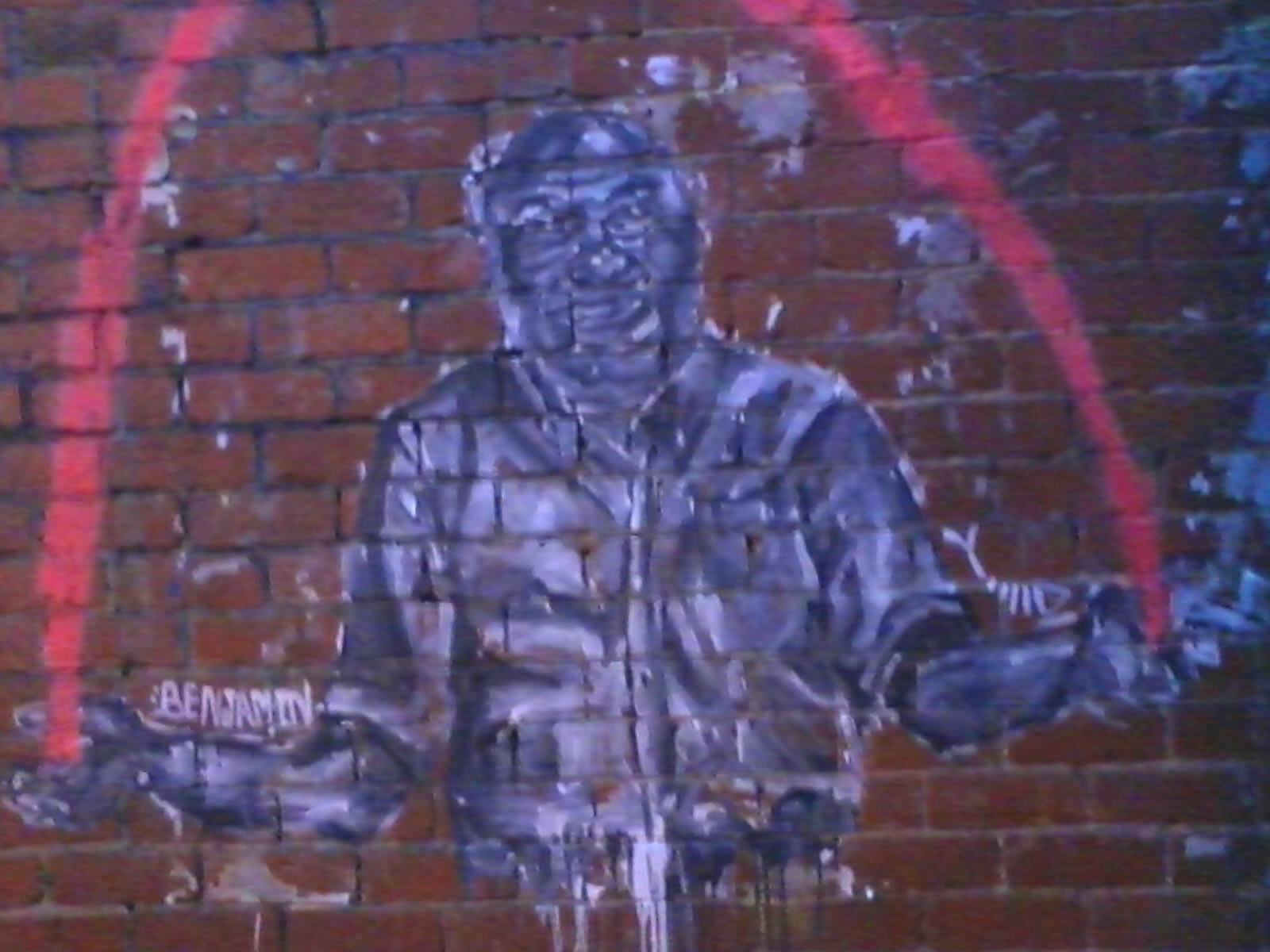
Benjamin’s been a busy boy!

benjaminA few weeks ago I was walking along one of my frequent haunts (my territory is huge),  when it started to rain unexpectedly, so I ran for cover and realised I was sheltering under an awning over-looking a recently adorned outdoor ‘piece’  – something I have determined as: “Man in Hawaiian style shirt”, signed by – someone who appears to be referred to as – “Benjamin”.

benjamin fishAbout a fortnight later, I happened to be about 2 kms away from that sighting, when I walked down a sidewalk lane and saw this particular piece. I suddenly realised it was by the same artist – “Benjamin”. What a find I thought. Followed by, “I wonder how many other pieces there are nearby”. A week later I went back – “Benjamin” was gone. It’s short life surprised me so much, I almost began to wonder whether I had really seen it or not!

benjamin-brollyAnother few weeks had gone by and I was well away in different territories finding out what’s new, what’s different, what’s disappeared,what’s been ‘dissed’, etc. when I decided to take a short-cut from the train station through a not-well known carpark at the back of a set of shops which my mother and I used to refer to as ‘the secret carpark’. So, for old time’s sake I decided to walk through the carpark, and low and behold, I found another Benjamin piece. I don’t know who you are – fancy letting me know?

Website | About | Facebook | Twitter

“Is It Art?”

Posted in StreetArt | Tagged | Leave a comment

Feeling a bit shattered?

crack glassHere we have a theme of a broken pane of glass. The first is a shattered glass pane of a window in a building. When I first looked at it, I barely thought of it as anything other than a broken pane of window probably caused by an act of vandalism.  After all, it is in an area where one would expect to see such acts of violence.  However, I couldn’t help thinking about it, so, camera in hand, went back and ‘snapped’ it.  This is because I remembered seeing  this painting (see below) by René Magritte entitled “The Key to the Fields” (1933) Claude Spaak Collection, Paris. This is a painting (which is considered art) depicting a broken window, glass falling inwards, suggesting a ball or something came through the window, shattering the glass and landing inside. What a pane!

magritte-windowNow suddenly I have discovered that it appears that René François Ghislain Magritte died 46 years ago on 15th August, 1967. (Quite shattering). Magritte, was a Belgian surrealist artist born in Lessines, on 21 November, 1898. Like some artists, he came from a troubled background. By the time he was 14, his mother committed suicide by drowning herself in the River Sambre. Many critics and followers surmise that, he was present after her death and that when his mother’s body was found, her dress was covering her face; an image that has been suggested as the source of several of his paintings in 1927–1928 of people with cloth obscuring their faces.

From 1916-1918, Magritte studied at the Académie Royale des Beaux-Arts in Brussels, under Constant Montald, after previously dabbling in Impressionistic styles. From 1918–1924 he was influenced by Futurism (an offshoot of Cubism).  To earn a living Magritte served in the Belgian infantry; worked as a draughtsman in a wallpaper factory; and was a poster and advertisement designer until 1926, when a contract with Galerie le Centaure in Brussels made it possible for him to paint full-time. He temporarilly relocated to Paris, but his success was not forthcoming, so he returned to Brussels in 1930 resuming work once more in advertising. After some time, he moved to London and stayed with his British surrealist patron Edward James who allowed him to stay rent free in his home and paint.

Alarmingly, over a period of two years from 1947–1948, Magritte, his brother and fellow Surrealist artist Marcel Mariën, supported themselves by reproducing fake Picasso’s, Braque’s and Chirico’s — a fraudulent repertoire he was later to expand into the printing of forged banknotes during the lean postwar period.  His recognition has come late. A Magritte Museum opened to the public on 30 May 2009 in Brussels. It is housed in the five-level neo-classical Hotel Altenloh, on the Place Royale, where  it displays some 200 original Magritte paintings, drawings and sculptures.

From the “Did you know…” files, apparently:

  • Jackson Browne’s  album “Late for the Sky”, (1974) artwork was inspired by Magritte’s “The Empire of Light”.
  • Tom Stoppard wrote a Surrelaist play entitled “After Magritte”.
  • Paul Simon’s song “Rene and Georgette Magritte with Their Dog after the War“, was inspired by a photograph of Magritte by Lothar Wolleh, which appears on the 1983 album “Hearts and Bones“.
  • In the 1992 movie, “Toys”, Magritte’s work was influential in the entire movie, but specifically in a break-in scene, featuring Robin Williams and Joan Cusack in a music video hoax.

Finally may I just say…”Mais oui, magnifique Magritte“.

Website | About | Facebook | Twitter

“Is It Art?”

Posted in StreetArt | Tagged , , | Leave a comment

Alannah Alarmer!

allanah-hillIf you’re a “girly” girl like me, you will be sobbing into your lace and bead-trimmed floral hanky. Australian fashion designer Alannah Hill, has announced splitsville from her label “Alannah Hill“, which she started nearly 20 years ago. What once began as a fledgling shop in trendy Chapel Street, Prahran, has grown into a mega empire of 16 stores, 15 factory outlets, and 28 spots within David Jones department stores within Australia and New Zealand.

Alannah actually names all of her creations. For example:

  • a multi-coloured cardi could be known as “Pass me By“;
  • a short-sleeved embellished top as “All For Glory“;
  • a pale pink beaded top entitled “Oh My! Oh My!“; or
  •  a pair of slacks entitled “KissMeOnTheBotty.

It appears that there has been an ongoing dispute between Alannah as designer; and Factory X, the firm that owns a majority of her brand. As a form of double-edged sword in order to survive, designers need the administration and production support of companies such as Factory X – who also owns Gorman, Jack London, Dangerfield and Claude Maus. 

Apart from myself, there are some celeb followers of Alannah fashion,  including Kylie Minogue, Nicole Kidman and Taylor Swift. Finally, from the weird facts or “Did you know“type files… Alannah apparently had a small role in the cult film Dogs in Space (1987) which starred Michael Hutchence (who for a brief time, dated Kylie Minogue). “Oh My! Oh My!

Website | About | Facebook | Twitter

“Is It Art?”

Posted in Embroidery, Fabric, Lace, StreetArt, Textiles | Tagged , , , | Leave a comment

You spin me ’round like a Cyclorama Drama going ’round, ’round, ’round…

Professor Michael Zeno Diemer RiesenrundgemaldeMany years ago on my first trip to the Tyrolean capital of Innsbruck, I discovered a unique curiosity painted in 1896, by Professor Michael Zeno Diemer (1867-1939). Apparently it only took about 3-6 months for him to create. It’s a panoramic oil on canvas, covering 1,000 square meters on the inside of a cylindrical platform, designed to provide the viewer standing in the middle of the cylinder with a 360° view of the painting.

This type of work is known as a cyclorama and this particular one, Riesenrundgemalde, is one of only 30 such maintained panorama paintings from the 19th century left worldwide. It depicts the War of Independence of the Tyrolese and features The Battle of Bergisel of August 13, 1809. During this battle, under the leadership of Andreas Hofer, the Tirolean farmers fought three heroic battles to defend their homelands against the superior forces of the French troops of Napoleon and his allies the Sachsen and the Bavarians. The panorama is also an interesting portrayal of Innsbruck. Amongst the rotund depiction it includes:

  • A priest administering the last rites to a dying fighter;
  •  views of “old Innsbruck” and the town area of Wilten
  • Saxon Prisoners contained within small houses; and
  • the brave leader Thalguter from Meran, leading his south-Tyrolese to the battle-line.

Hence, the drama of this cyclorama… “Keeps on going right ’round, baby, right ’round, ’round, baby right ’round, ’round, ’round, ’round. (To the tune of Dead or Alive’s – You Spin Me Around).

Website | About | Facebook | Twitter

“Is It Art?”

Posted in Paintings | Tagged , , , , , , | Leave a comment

“Anything, but a load of old Bosch!”

 Hieronymous Bosch garden of earthly delightsI guess when people refer to something as ‘a load of old Bosch,‘ I hope they aren’t referring to the great artist Hieronymous Bosch. Bosch died some 497 years ago on the 9th August 1516, having been born ca. 1450. He is also known as Hieronymus van Aken (Aachen); after the city from which his family originated. Apparently, both his father and grandfather were  both painters.

His most famous work “The Garden of Earthly Delights”, was painted roughly between 1490-1500. This triptych looks so modern and extraordinarily fresh today, that it beggars belief to think that this masterpiece was painted nearly 500 years  ago. What fascinates me most, is the fact that the depictions have not dated.

Since 1939,“The Garden of Earthly Delights”  has resided in the Museo del Prado, in Madrid. The triptych is painted in oil on oak and is formed from a square middle panel flanked by two further oak rectangular wings that close over the center as shutters. The outer wings, when folded, show a grisaille painting of the Earth during the Biblical narrative of Creation. The three scenes of the inner triptych depict (from left to right):

  • God presenting Eve to Adam;
  • a broad panorama of socially engaged nude figures, fantastical animals, over sized fruit and hybrid stone formations; and a
  • Hell-scape portraying the torments of Hell and damnation.

A load of old Bosch? – I don’t think so.

Website | About | Facebook | Twitter

“Is It Art?”

Posted in OilPainting, Paintings | Tagged , , , | Leave a comment

“The Eagle Will Rise Again…”

Bruce Armstrong EagleEagle, a 25 meter-high sculpture by Bruce Armstrong has been keeping a watchful eye from his perch in Wurundjeri Way, in the Docklands precinct of Melbourne for over a decade. Majestic in his stature, the  timber, aluminium and glass statue represents the spirit creator of the Kulin nations which include the Wurundjeri people.  However, just when you thought that “the eagle had landed,”  it would appear that this 20-tonne “big bird” has been issued with an eviction notice.

Apparently, his eyrie is considered to be sitting in prime real estate territory and has been marked for further (and as if it is needed), development; including a mix of high-rise office space and 600 new apartments with a public plaza in the middle.  But what is more disturbing is that it appears that both the sculptor (Armstrong) and the Wurundjeri Tribe Land Cultural Heritage Council had not been informed of Eagle/Bunjil’s future.

I am disturbed by this.  I want to help Bunjil from becoming an endangered species of art. As an inspirational message,  I’ll leave you with an opportunity to listen to a song from the 1978 album “Pyramid” by The Alan Parson Project, entitled (and in this case, the very apt) “The Eagle Will Rise Again“.  It starts:

And I could easily fall from grace,
Then another would take my place
For the chance to behold your face…”

Website | About | Facebook | Twitter

“Is It Art?”

Posted in Sculpture, StreetFurniture | Tagged , , , , | Leave a comment

The Kinks vs the Honorable Mrs. Graham

thomas gainsborough honorable mrs. grahamBelieve it or not, but it was 225 years ago that 65 year-old English portrait and landscape artist, Sir Thomas Gainsborough died, on 2nd August, 1788.  As the youngest son of a Suffolk weaver, John Gainsborough, Thomas  was Christened on 14 May 1727.

In 1769, at the age of 42, he became a founding member of the Royal Academy, but his relationship with the organization was thorny and he often withdrew his work from exhibition. Gainsborough moved to London and by 1774, focused  on portraiture including the then King and Queen of England. Unfortunately to Gainsborough’s disadvantage, the King was obliged to name as Royal painter, Gainsborough’s rival,  Joshua Reynolds. One of his more famous works includes this piece,  Portrait of Mrs. Graham; (see above) which is located at the National Gallery of London.

So, what has this got to do with the 60’s band The Kinks? Well, their 1971 album entitled ‘Muswell Hillbillies‘, contains the song “20th Century Man”.  Apparently, Ray Davies lists Gainsborough as one of the painters he prefers to as:  “your smart modern painters.” – Obviously, a “well-respected man“.

Website | About | Facebook | Twitter

“Is It Art?”

Posted in OilPainting, Paintings | Tagged , , , , , | Leave a comment