There’s no snubbin’ a good oil paintin’ by Frederick McCubbin

Above: The Wallaby Track (1897) oil on canvas Art Gallery of New South Wales

Frederick McCubbin  was born in West Melbourne, the third of eight children on 25 February 1855. He was a prominent artist from the Heidelberg School, one of the most important historical artistic movements in Australia. He studied art at the National Gallery of Victoria’s School of Design, where he met Tom Roberts and studied under Eugene von Guerard. He also studied at the Victorian Academy of the Arts where he exhibited in 1876 and again from 1879-1882, selling his first painting in 1880.

  • In 1888, he became instructor and master of the School of Design at the National Gallery. In this position he taught a number of students who themselves became prominent Australian artists, including Charles Conder and Arthur Streeton. Featured right: Bush Idyll (detail) oil on canvas.

McCubbin married Annie Moriarty in March 1889. They had seven children, of whom their son Louis also became an artist.

  • (Featured above: Autumn Memories (1899) oil on canvas. The Joseph Brown Collection, NGV Foundation). This is one of his most lyrical and romantic images. It shows his fascination for placing female figures in the open landscape. Annie McCubbin (his wife) became a poetic motif for the transience of nature and the warm, afternoon autumnal light dissipates and fades becoming, as the title suggests, an evocative memory.

He won a number of prizes from the National Gallery, including a first prize in 1883 in their annual student exhibition. By the mid-1880s he concentrated more on painting the Australian bush, the works for which he became famous.

In 1901 McCubbin and his family moved to Mount Macedon, transporting a prefabricated English style home up onto the northern slopes of the mountain which they named Fontainebleau. It was in this beautiful setting that he painted The Pioneers amongst many other works and this is the only place that McCubbin ever painted fairies.

  • The Pioneers (1901) oil on canvas triptych can be viewed at the National Gallery of Victoria, Melbourne (Felton Bequest). This is one of the last of McCubbin’s large compositions and the most characteristic of this middle period of his development.

Part of McCubbin’s legacy is intertwined with that of fellow Australian artists Tom Roberts and Louis Abrahams who founded the first artist’s camp at Box Hill in the eastern outstretch of Melbourne which laid the foundations of what later became “The Heidelberg School“.

  • In 1912 he became the founding member of the Australian Art Association.
  • Frederick McCubbin died on 20 December 1917, at South Yarra from a heart attack.

Sources: Gleeson, James. Australian Painters | McCulloch, Alan. “Encyclopedia of Australian Art”

Website | About | Facebook | Twitter

“Is It Art?”

Posted in Art, Artists A-Z, Gallery Art, OilPainting | Tagged , , , , , , , | Leave a comment

Daubigny took to art like a duck takes to water

daubigny - springFrench artist Charles-François Daubigny is considered an important precursor of the Impressionistic Art movement. Born in Paris into a family of painters  on 15th February 1817, Daubigny was taught by his father Edmond François Daubigny and his uncle, miniaturist Pierre Daubigny. Initially François painted in a traditional style, but after moving to the Barbizon School in 1843 he began painting outdoor scenes along the Seine and Oise, often in the region around Auvers.

It was during this time that Daubigny bought a boat Botin, which he turned into his studio. By 1852 he came under the influence of both Gustave Courbet and Camille Corot in Optevoz (Isère). In 1866 he visited England, eventually returning to France due to the Franco-Prussian War in 1870. It was during his London visit that he met Claude Monet and on his return to Auvers, he met Paul Cézanne.

  • Daubigny’s finest pictures were painted between 1864-1874, which were predominantly landscapes featuring trees, a river and a few ducks.
  • Although there are two large landscapes by Daubigny in the Louvre in Paris; neither contain a river view.  One of these is: Springtime (1857) – featured above.

daubigny marsh at sunset 1861It has been said that when Daubigny liked his pictures he added another duck or two. Therefore, the greater number of ducks often indicated greater appreciation of his work.

Above is Marsh at Sunset (1861) which features by my count up to 16 ducks, so maybe this indicates that he was more than appreciative of this work.

  • Daubigny became an Officer of the Legion of Honor.  He died in Paris on 19th February, 1878 and was interred at Cimetière du Père-Lachaise (Division 24).

I wonder, is Daubigny’s success and artistic merit based on the ducks of the class (in his paintings); or on his sheer artistic talent –  to make him the Dux of the Class?

  • The latter I’m sure!

Website | About | Facebook | Twitter

“Is It Art?”

Posted in Art, Artists A-Z, Gallery Art, OilPainting, Paintings | Leave a comment

Did Benois’ Part Create a Surge in Diaghilev’s Balletic Art?

The above portraiture is of Serge Diaghilev (1872-1929) illustrated by Alexandre Benois over a proscenium arch from which the showman from Petruschka draws the curtains to reveal a scene from Le Pavillion d’Armide, with Petruschka hiding in the corner.

Russian artist Alexander Benois aka Alexandre Nikolayevich Benois was born on 3rd May, 1870 in St. Petersburg into an artistic and intellectual family, who were prominent members of the 19th and early 20th-century Russian intelligentsia. Not planning a career in the arts he graduated from the Faculty of Law, St. Petersburg Imperial University, in 1894.

During his life he has been described as an influential artist, art critic, historian, preservationist and founding member of Mir iskusstva (World of Art), an art movement and magazine along with Sergei Diaghilev and the artist Léon Bakst which promoted the Aesthetic Movement and Art Nouveau in Russia. According to Wikipedia; as a designer for the Ballets Russes under Diaghilev, Benois was considered a seminal influence on modern ballet and stage design.

  • In 1901, Benois was appointed scenic director of the Mariinsky Theatre in St. Petersburg, the performance space for the Imperial Russian Ballet.
  • In 1903, Benois printed his illustrations to Pushkin’s poem The Bronze Horseman, a work since recognized as one of the landmarks in the genre.
  • In 1904, he published his “Alphabet in Pictures,” at once a children’s primer and elaborate art book, and copies have sold at auction for US$10,000. (Illustrations from “Alphabet in Pictures,”were featured on video during the opening ceremony of the Winter Olympics in Sochi in 2014).
  • He moved to Paris in 1905 and thereafter devoted most of his time to stage design and decor. During these years, his work with Diaghilev’s Ballets Russes was ground-breaking.
  • His sets and costumes for the productions of Les Sylphides (1909), Giselle (1910), and Petrushka (1911), are counted among his greatest triumphs.

Although Benois worked primarily with the Ballets Russes, he also collaborated with the Moscow Art Theatre and other notable theatres of Europe. Surviving the upheaval of the Russian Revolution of 1917, Benois achieved recognition for his scholarship and was selected as curator of the gallery of Old Masters in the Hermitage Museum at Leningrad, (1918-1926).

  • In 1927 he left Russia and settled in Paris where he worked primarily as a set designer until his death on 9th February 1960, in Paris.

By the way, Petrushka’s were used as marionettes, as well as hand puppets in Russia. Traditionally he was a kind of a jester distinguished by his red dress and often portrayed as having a long nose – what is not dissimilar to Punch or Pulcinella in character.

If that is the case, then “That’s the Way To Do It!”

Website | About | Facebook | Twitter

“Is It Art?”

Posted in Art, Artists A-Z, Gallery Art, Illustrations, OilPainting, Paintings, Performing Art | Tagged , , , , , | Leave a comment

May the Mather Inlaid Layer Remain a Major Lasting Stayer

Scottish-born Australian plein-air painter and etcher John Mather was born in Hamilton, South Lanarkshire in 1849. After studying art at the Royal Glasgow Institute of the Fine Arts he migrated to Australia in 1878.  By 1880, Mather was partly responsible for the decoration of the dome of the Royal Exhibition Building, Melbourne. He was appointed to the board of trustees of the Public Library, Museums and National Gallery of Victoria in 1892 and a founding member of the Victorian Artists’ Society, and its President from 1893-1900, 1906–08 and 1911. Mather worked as a house decorator. He was a member of the Felton Bequest Committee (1905–1916) and as trustee, strongly supported Australian art.

  • As a painter, Mather was also involved in the bohemian Artists’ Camps of Sydney. In 1912 along with Frederick McCubbin, Max Meldrum, and Walter Withers; Mather formed the breakaway Australian Art Association.
  • Three of Mather’s own paintings, Autumn in the Fitzroy Gardens,Morning – Lake Omeo and Wintry Weather – Yarra Glen were purchased by the National Gallery of Victoria (NGV).
  • Mather died of diabetes at his home, Cadzow, in the inner Melburnian suburb of South Yarra on 18 February 1916 and is buried in the Cheltenham Pioneer Cemetery.

As a decorator; an example of Mather’s work can be found at the NGV within the inlay design of a cabinet made of both East Indian and West Indian satinwood, other timbers and glass. It was made in 1880 by local Melbourne manufacturer W.H Rocke & Co which was established by William Henry Rocke who arrived in Melbourne aged 16 and established an important furniture importing and manufacturing business. He participated in the inter-colonial and international exhibitions including the 1880-81 Melbourne International Exhibition for which this cabinet (featured above)  was exhibited. Constructed in the Old English style; it is one of the many revivalist styles of the Aesthetic Movement and combines elegant inlaid decorations with panels painted by John Mather. (Courtesy of NGV Bequest of Mrs. Stella Hawkes 1991).

Website | About | Facebook | Twitter

“Is It Art?”

Posted in Architecture, Art, Artists A-Z, Furniture & Furnishings, Gallery Art | Tagged , , , | Leave a comment

Here is a Valentine’s Day Post

If you think “posting” thoughts is something belonging to the 21st Century form of communication, think again. People have been “posting” their thoughts for hundreds of years. Here’s an example of 19th-20th Century posting. The above image is entitled: “Love’s Letter Box” by Arthur Hopkins (1848-1930). It depicts a young maiden posting a secret letter to her lover in their pre-arranged letter box.  I wonder if this was “posted” on St. Valentine’s Day?

St. Valentine was a martyr whose Saint’s day is celebrated each year on 14th February. There are two Valentine’s who vie for this title. One was a Roman priest who was martyred on the Falminian Way under Claudius; the other, a Bishop of Terni who was martyred in Rome but whose relics were translated to Terni. Some even claim that both of these persons are one and the same. However; neither have any connection with lovers or courting couples. It has been suggested that St.Valentine’s Day is celebrated on 14 February because it is the day when birds are supposed to pair – a belief at least as old as Chaucer. (from The Oxford Dictionary of Saints, 1978).

This may also explain Shakespeare’s reference to St. Valentine in his Midsummer Nights Dream [145]: “St. Valentine is past: Begin these wood-birds but to couple now?”

As for the artist: Arthur Hopkins, the son of a prosperous marine insurance agent, was born on 30th December, 1848, in Stratford, London. He was educated at Lancing College in Sussex and after graduation worked in a London office before entering the Royal Academy school in 1872.

He exhibited in various London galleries including the Royal Water-Colour Society as well as the Royal Academy, painting in the genre of scenes of country life As an illustrator, he  contributed many illustrations over a 25 year period to The Graphic, Punch, and The Illustrated London News. He was made an Associate of the Royal Water-Colour Society in 1877 and became a member in 1896.

Although he died in 1930, his romantic and other works still touch hearts today, let alone this ‘early’ post to a young maiden’s lover.

To Wit or To Woo – A Happy St. Valentine’s Day to You!

Website | About | Facebook | Twitter

“Is It Art?”

Posted in Art, Artists A-Z, Illustrations, OilPainting, Paintings, Watercolours | Tagged , , , , , , , | Leave a comment

Never Sour of this Tower of Dutch Flower Power

Dutch painter Jan van Huysum (alt. Huijsum), the son of the flower painter Justus van Huysum, was born on 15th April 1682.  Jan is considered to be both a skilled still life and landscape painter. Half of his pictures in public galleries are landscapes with views of imaginary lakes and harbours, ruins; and woods of tall trees.  Some examples of this work are part of the Louvre Gallery art collection in Paris.

Van Huysum died on 8th February, 1749.

Some of the finest of van Huysum’s fruit and flower pieces such as the two featured above have been in English private collections; such as those from the Earl of Ellesmere’s gallery; the collections of Hope and Ashburton; and at the National Gallery, London.

Other major van Huysum collections are part of the following national or major European art galleries in: Amsterdam, Berlin, Brunswick, Carlsruhe, Copenhagen, Dresden, Hanover, Munich, St Petersburg, The Hague and Vienna; as well as Boston in the USA.

  • The first image featured above is entitled “Flowers in a Vase” and the second, “Fruit and Flowers” and are both from the Wallace Collection, London.

Website | About | Facebook | Twitter

“Is It Art?”

Posted in Art, Artists A-Z, Gallery Art, OilPainting, Paintings | Tagged , , , , , , | Leave a comment

Who is Silvia? – Perhaps Elmore Knows

alfred elmore - subject from two gentlmenWho is Silvia? what is she,
That all our swains commend her?
Holy, fair, and wise is she;
The heaven such grace did lend her,
That she might admirèd be.

“Who is Silvia?” is an aged rhetorical question which stems from the Shakespearean play – “The Two Gentlemen of Verona.”  To help us realize this conundrum, English artist Alfred Elmore  has not only captured the ideal of Silvia, but also “the moment of much action’. Here we see the ‘dozing’ Duke in a velvet chair. Behind him, Valentine makes an advance towards Silvia; who pushes him away.  She is also seen to direct a cautionary glance towards her reclining father, thinking he is asleep, but cannot see that he is actually awake and that his suspicious eyes are open.

Alfred W. Elmore  (1815–1881) was a Victorian history and genre painter. Born in Clonakilty, Cork, Ireland, the family moved to London, where Elmore studied at the Royal Academy of Arts. His early works were in the ‘Troubadour style” of Richard Parkes Bonington, but he soon graduated to religious work, notably The Martyrdom of Thomas à Becket, commissioned for the Westland Row Church, Dublin. Most of his later works were historical narrative paintings, including episodes from Shakespearen plays.

  • From 1840-1844 Elmore travelled across Europe, visiting Munich, Venice, Bologna, and Florence.
  • According to his friend William Powell Frith, Elmore became a member of The Clique; a group of young artists who saw themselves as followers of William Hogarth and David Wilkie.
  • By the late 1860s Elmore was moving towards a more classical style influenced by Edward Poynter and Lawrence Alma-Tadema.
  • Elmore’s continuing battle with neuralgia along with other conditions, led to his sad demise from  cancer in January 1881.
  • He was buried at Kensal Green Cemetery in London.

Website | About | Facebook | Twitter

“Is It Art?”

Posted in Artists A-Z, Gallery Art, Paintings | Tagged , , , | Leave a comment

Charles Bryant’s – Rabaul without a cause

charles-bryantCharles David Jones Bryant (11 May 1883 – 22 January 1937) was an Australian marine artist. Born at Enmore in Sydney, he was educated at Sydney Grammar School.

Bryant studied painting under William Lister Lister and was an exhibitor at the Royal Art Society of New South Wales for some years. He went to London in 1908 and studied with John Hassall and Julius Olsson, A.R.A., at St Ives, in Cornwall. He exhibited at the Royal Academy and the Paris Salon, where he received an honorable mention for “Morning Mists” in 1913, and with many well-known societies.

He was appointed an official war artist on the Western Front in 1917 and commissioned  many paintings for the Australian government. Sixty-nine of these are part of the Australian War Memorial collection in Canberra.

    • In 1922, Bryant returned to Australia and in 1923 was sent to the mandated territories in New Guinea to paint scenes of the occupation by the Australians.
    • In 1925, he painted a picture of the American fleet which was presented by Sydney citizens to the United States government. This picture is now at the Capitol, Washington.

Returning to England; some 10 years passed before Bryant returned to Australia.

    • He had a very successful one-man show in Sydney towards the end of 1936, which was followed by another in Melbourne.
    • He held various official positions with art societies, having been a member of the council of the Royal Institute of Oil Painters, a vice-president of the Royal Art Society, Sydney, and president of the London Sketch Club.
    • He is represented in the Sydney, Melbourne, Adelaide, Castlemaine and Manly galleries, as well as the Australian War Memorial and the Imperial War Museum, London.

Unmarried, he died at Manly, Sydney on 22 January 1937 and he was buried in the  Church of England cemetery.

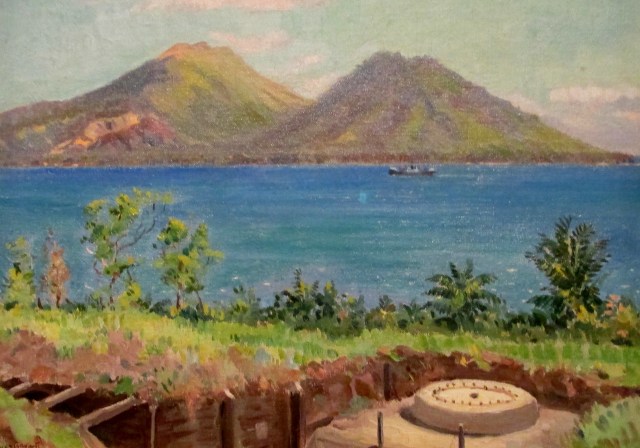
  • Above image – The Harbour from Fort Raluana, Blanche Bay was painted in Rabaul, New Britain, 1923. (oil on canvas on cardboard, acquired under commission in 1924 –  Australian War Memorial, Canberra).

Website | About | Facebook | Twitter

“Is It Art?”

Posted in Artists A-Z, Gallery Art, OilPainting, Paintings | Tagged , , , , , , , | Leave a comment

Any port in a storm seems a far cry for Ambrogiani’s Le Port

ambrogiani - le portFrench Expressionist painter, print-maker and sculptor Pierre Ambrogiani was born on January 16, 1907 in Ajaccio located on the west coast of the island of Corsica, 210 nautical miles (390 km) southeast of Marseille, France.

Ambrogiani is known for his bright colors mainly in oranges and reds, used in portraits and landscapes, particularly in harbor scenes and still life paintings along the countryside and the Mediterranean Sea.

  • Largely self-taught; by the age of 30 he had his first exhibition in Marseilles.
  • In 1946, he held an exhibition in Paris, and in the following year in New York City.
  • During the 1960s he began engraving and decorating frescoes and stained glass windows to which an example can be found at the Church of the Immaculate Conception in Marseille.
  • A retrospective of his work was held in Marseilles in 1973 and shortly after that he was disabled by ill health.

Ambrogiani died on September 23, 1985 and was buried in Saint -Pierre de Marseille. His body was transferred to the cemetery of Sault in Vaucluse.

  • Above image is entitled ‘Le Port.’

Website | About | Facebook | Twitter

“Is It Art?”

Posted in Artists A-Z, Gallery Art, OilPainting, Paintings, Sculpture, Stained Glass | Tagged , , | 1 Comment

In true Fassianos fashion I present Le Cyclist

fassianos - le cyclisteAcclaimed Greek artist Alekos Fassianos was born under the sacred rock of Acropolis in 1935. He is renowned for his work based on Greek mythology and Byzantine iconology artworks as well as artworks relating to shadow theatre. His mother was a philologist (who studied language in written historical sources) and who introduced him to the ancient culture and the French language.

During his informative years, Fassianos studied violin at the Athens Conservatory and later painting at the Athens School of Fine Arts, from 1956 to 1960. He then went to Paris on a French State scholarship during 1962–1964, where he attended lessons on lithography.  In 1966 he lived and worked solely in Paris and from 1974 onwards, he divided his time between Paris and Athens. All told, Fassianos studied in Paris for 35 years and received one of its greatest honors “Celebrities of the Officer of the Legion of Honor” by the French Ambassador Jean-Louis Delfosse; via the French Embassy in Athens.

His artistic figures are known for their voluptuousness and his use of luminosity of color highlights the sensuality and the immense pleasure he sees in daily life. His works from the 1960s were modeled on an “Expressionist” style and during this period his figures appeared to become grotesque.

  • Since his first Athens exhibition in 1959, he has shown more than 70 personal exhibitions in Paris, Athens, Thessaloniki, Milan, New York, London, Tokyo, Beirut, Hamburg and Munich to name but a few.
  • He was invited to produce stamps and posters for the Athens 2004 Olympics.
  • His works are exhibited today in museums and private collections in Greece and abroad.
  • Image featured above is: “Le Cyclist.”

For further information click here.

Website | About | Facebook | Twitter

“Is It Art?”

Posted in Artists A-Z, Gallery Art, OilPainting, Paintings | Tagged , , , , , | Leave a comment

Tom Civilian is Too Civil by Half

Civilian wall insetStreet artist Civilian – (aka Tom Civil) is a Melbourne street artist born in 1978. He came to Melbourne for the S11 blockades for the World Economic Forum in 2000 and decided to stay.

Since then, Civil or Civilian has presented “empty shows” in abandoned spaces – a description for illegal exhibitions held in derelict buildings; however, in 2003 the local Melbourne police caught him at a suburban location in Canterbury with an “Empty show” in progress, but, no criminal charges were laid.

CivilianCivil’s work maintains a strong graphic design theme using stencil, woodcuts and poster design murals. He often focuses his art on political and activist content. He has commented:

I think that’s the thing with street art. Its about the experience of it and the transient nature of it all means you’re so lucky to find a little stencil hidden away, and the next time you pass it or grab a friend to show them, its gone”.

“What’s beautiful about street art is the secrets and discovering those hidden things. It’s exploring a city, being urban explorers. It makes me think of the Cave Class, the people that explore the tunnels and drains under the city or the empty shows. Its about discovery.”

Some of his walls and murals include:

  • Warmun (East Kimberley) a project with the Gija community
  • Singapore
  • Cockatoo Island and Campbelltown Sydney
  • Mural workshop, Armidale NSW
  • Cans Festival London
  • Dight Falls, Yarra River and inner suburban areas of Melbourne including Collingwood Carlton and Brunswick, to name but a few.

“- Too Civil by Half” is attributed to Richard Brinsley Sheridan (1751-1816) who was an Irish playwright and poet and long-term owner of the London Theatre Royal, in Drury Lane.

Website | About | Facebook | Twitter

“Is It Art?”

Posted in SprayCanArt, Stencils, Street Artists A-Z, StreetArt, StreetArtists | Tagged , , , , | Leave a comment

Blessed Beatrice be thy name

beata beatrix1Beata Beatrix  (Engl. trans. ‘Blessed Beatrice‘, 1870) is an oil on canvas painting by Pre-Raphaelite artist Dante Gabriel Rossetti. It depicts Beatrice Portinari from Dante Alighieri’s poem La Vita Nuova at the moment of her death. La Vita Nuova had been a story that Rossetti had found of interest from childhood and he had begun work translating it into English in 1845 and published it in his work, The Early Italian Poets.

  • Rossetti modeled Beatrix after his deceased wife and frequent model, Elizabeth Siddal, who died in 1862.
  • In a letter in 1873 to his friend William Morris, Rossetti said he intended Beata Beatrix “not as a representation of the incident of the death of Beatrice, but as an ideal of the subject, symbolized by a trance or sudden spiritual transfiguration.
  • The artwork is part of the Tate Britain collection, gifted in memory of Francis, Baron Mount-Temple by his wife, Georgiana in 1889.
  • Apart from this version, there are a small number of replicas of Beata Beatrix and all have subtle differences.

Website | About | Facebook | Twitter

“Is It Art?”

Posted in Artists A-Z, Gallery Art, OilPainting, Paintings | Tagged , , , , , , , , | Leave a comment

You must remember this, a Kiss is just a kiss

isobel gloagIsobel Gloag – “The Kiss of the Enchantress c. 1890
This painting depicts a young soldier being trapped by a Lamia. Among the Greeks and Romans, a Lamia was a female demon who devoured children and whose name was used to frighten them. She was a Libyan queen beloved by Jupiter, but robbed of her offspring by the jealous Juno. She became insane and vowed vengeance on all children whom she delighted to entice and devour. The race of Lamiae in Africa were said to have the head and breasts of a woman and the body of a serpent. They enticed strangers into their embraces to devour them.

During the Middle Ages witches were also called Lamiae.  The Keat’s poem Lamia (1820) recounts how a bride when recognized by Apollonius of Tyana as a serpent or lamia vanished in an instant. Keats took the substance of his poem from Robert Burton’s Anatomy of Melancholy (1621) for which the source was Philostratus (De Vita Apollonii, Bk iv (3rd Century AD). The word Lamia derives from the Greek: Lamuros (voracious, gluttonous).

Isobel Lilian Gloag was born in London in 1865 to Scottish parents from Perthshire. She studied at St John’s Wood Art School and Slade, followed by producing studio work at M.W. Ridley’s studio.

  • She attended life classes at South Kensington before travelling to Paris to study under Raphael Collin.
  • Returning to London, she took a studio in Notting Hill, exhibiting at the Royal Academy from 1893 onwards; where her first exhibit was entitled A Raw Recruit.
  • As well as painting romantic subject pictures reminiscent of Byam Shaw and Gerald Moira, she was a consummate portraitist, illustrator and stained glass window designer.
  • She also designed posters and produced flower paintings.
  • After a life plagued by ill health, Isobel Gloag died on the 5th of January 1917 aged 52.

An article in the Magazine of Art 1902 (pp. 289-292) by James Greig, comments upon her paintings and illustrations.  Gloag is also listed in Christopher Wood’s Dictionary of Victorian Painters; whilst Simon Houfe’s Dictionary of 19th Century British Book Illustrators lists her known graphic works.

Website | About | Facebook | Twitter

“Is It Art?”

Source: Phillpotts, Beatrice. Mermaids. Ballantine, New York. 1980
Posted in Artists A-Z, DarkArt, Gallery Art, Illustrations, Paintings | Tagged , , , , , , , , | 1 Comment

A picture is worth a thousand words

jean-baptiste regnault - empress josephineAbove image: Empress Josephine (ca 1810) oil on canvas by Jean-Baptiste Regnault Foundation Desne-Theos (Institute de France) Paris, (Frederic Masson Bequest).

Empress Josephine is also known as Josephine Bonaparte (1763-1814). She was baptized Marie-Joseph Rose de Tascher de la Pagerie and born into an aristocratic Creole family on the Caribbean island of Martinique.

After a disastrous early marriage in France, Josephine was allowed to claim her former husband’s possessions after the Reign of Terror Revolution and used her new found status to launch herself as one Paris’s leading society hostesses. She met Napoléon Bonaparte in 1795 and a year later they were married in 1796, when she was 33 and he was 28 years old.

Glamorous and sophisticated, Josephine was a style icon creating some of the most elegant interiors of the Consular Period and created a garden famous for its exotic flora and fauna which she developed when she purchased Malmaison estate outside of Paris. She was fascinated with Australian flora and fauna and engaged some of the best garden designers of the time to create her paradise and keep her menagerie of animals including kangaroos, emus, a red-necked wallaby, cockatoos and black swans.

Regnault | Venus Preparing Herself

Regnault | Venus Preparing Herself

French painter and artist, Jean-Baptiste Regnault was born in Paris on 9 October 1754. At the age of 15, his artistic talent attracted much attention and he was sent to Italy by M. de Monval under the care of Bardin to continue with his studies.

After his return to Paris in 1776, Regnault won the Grand Prix for his painting Alexandre and Diogène. His diploma picture, the Education of Achilles by Chiron, is now in the Louvre, as also is the Christ taken down from the Cross, originally executed for the Royal Chapel at Fontainebleau.

Jean-Baptiste Regnault was married first to Sophie Meyer, then later to Sophie Félicité Beaucourt. He died in Paris on 2nd November, 1829 and is buried in Père-Lachaise Cemetery, Paris.

  • Napoléon Bonaparte is famous for stating, “A picture is worth a thousand words.
  • I wonder whether he was referring to this painting?

Website | About | Facebook | Twitter

“Is It Art?”

Posted in Gallery Art, Illustrations, OilPainting, Paintings, Watercolours | Tagged , , , , | Leave a comment

Grace’s Home Through the Looking Glass

grace cossington-smith door into the gardenGrace Cossington Smith Door Into the Garden, 1959. Oil on composition board. – Bendigo Art Gallery.

Australian artist and pioneer of modernist painting in Australia, Grace Cossington Smith was born Grace Smith, on 20 April 1892 in Neutral Bay, Sydney. She attended Abbotsleigh School for Girls in Wahroonga from 1905–1909 and from 1910-1914 studied art in both Australia and the United Kingdom. She adopted the middle name “Cossington” in 1920 which was an early family name. Her work was greatly respected by fellow-artists Roland Wakelin and Roy de Maistre. She exhibited with the Royal Art Society of New South Wales from 1915, the Society of Artists from 1919 and Thea Proctor’s Contemporary Group at Adrian Feint’s Grosvenor Gallery from 1926–28, and from 1932 to 1971, at the Macquarie Galleries.

Her painting style was characterized by her individual, square brush strokes with bright unblended colours.  She received acclaim late in her career and in 1973; a major retrospective exhibition of her work toured Australia.

  • As shown in these images, many of her scenes give a glimpse of the ordinary suburban home of her time: still lives, doorways and window sills.
  • Many of her room interior creations show the same room from different angles, or even multiple views from a slightly different or same angle.
  • In some paintings a door or window is the dominant focus for the painting, while in others, the viewer is shown the entire room.

Interior settings became a late theme for Grace Cossington Smith and the painting above shows the door from the artist’s studio into the back garden of her home in Turramurra. She lived in the same house all her life and from the intimate interior with all her familiar furniture, we are led through open doors into the garden beyond. Her pure use of pigment and stippled brushwork create a flood of golden light. Cossington Smith’s art is important not only for the personal qualities she brought to her work; but for demonstrating a significant response to European Post-Impressionism.  Examples of her work are held by every major gallery in Australia.

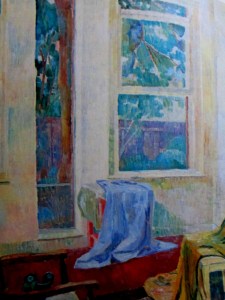
grace cossington-smithHer large oil, Interior with verandah doors of 1954, (seen right) shows an accurate depiction of her house with a large window and a door opening to the outside on the other side of the bed. She used great sunlight and wonderful patterns of vibrant colour with cool colours added to shadows, giving them a sense of energy. Her use of colour has been compared to the work of Pierre Bonnard, though she said she found Cézanne a more important influence on her work.

In 1973 Smith was made an Officer of the Order of the British Empire (OBE) for her services to Australian art. She was appointed an Officer of the Order of Australia in 1983. The Governor of New South Wales visited Grace Cossington Smith in her nursing home to award her the honour.

She died on 10 December 1984 in Roseville, New South Wales.

Posted in Artists A-Z, Paintings, Watercolours | Tagged , , , , , , , | Leave a comment